
Mind Over Matter
Why the Human Mind Is the Source of Wealth

This article is an excerpt from the inaugural Defenders of Capitalism newsletter published on January 16. You can find the full newsletter—and subscribe to future editions—on the Defenders of Capitalism website.
On bitter winter mornings, as I crank up the heat in my home, I rarely stop to think about what makes my comfort possible.
But I should.
Long ago, over many millions of years, the remains of algae and microscopic animals fell to the ocean floor. Buried under layers of sediment and subjected to intense heat and pressure, this organic material decayed into hydrocarbons. Early civilizations encountered natural seeps of petroleum, using it for crude medicine and construction, but remained ignorant of its chemical potential.
John D. Rockefeller’s company mastered the industrial-scale refinement of this black sludge, providing cheap fuel for people across the world. More than a century later, I am a proud beneficiary of that achievement. I remain warm year-round for less than two dollars a day, living in a level of comfort unimaginable even to the most powerful ancient rulers.
The Alchemy of Intellect
Our planet is not a treasure chest opened and consumed at will to satisfy our needs. The Earth is a repository of ingredients—raw matter without inherent purpose. Across the vastness of history, rubber was the easily rotted sap of a tree, and mold an opportunistic fungus. Then Charles Goodyear vulcanized rubber for the tires, belts, and seals that would mobilize twentieth-century industry; Alexander Fleming discovered a method for converting fungus into penicillin and saving the lives of untold millions from bacterial infection. The creation of wealth requires the deliberate application of intellect into reality.
Value was never embedded in the primordial organism buried and liquefied eons ago, nor in the sap or the mold; the bedrock of value lies in the recipe—as conceived by the human mind—upon which abundance and progress are rooted.

Human history is crowded with brilliant and enterprising individuals. Millennia ago, Roman architects constructed vast aqueducts to transport fresh water into cities, while Egyptian administrators designed immense pyramids to precise geometric specifications.
But the soil for genius was soured—the conditions to properly unleash creativity could not take root in such barren ground. The Roman republic’s bitter civil wars gave way to one-man authoritarian central planning under the empire. Egypt’s grandiose monuments were created at the direction of megalomaniacal god-kings with a monopoly over all property in the country. Brute force and coerced labor could not produce the widespread, compounding prosperity that emerged in the 1800s.
The Convergence of 1776
The modern world’s prosperity required a fundamental shift in the organization of society. Western civilization today enjoys the Enlightenment’s inheritance, and the writings of its great thinkers remain essential reading for anyone seeking to understand American civilization. For our purposes, the year 1776 serves as a convenient marker for the birth of capitalism—and the growing recognition of individual rights that propelled humanity forward.
The Declaration of Independence represented far more than a political separation from Great Britain. Its central argument rejected kingship and affirmed every person’s right to “life, liberty, and the pursuit of happiness.” These ideals, founded in freedom, enshrined the individual’s ability to use his or her mind for self-actualization, rejecting the notion that human effort should be directed toward the arbitrary demands of the state or the whims of a ruler.
And not only did 1776 produce one of the most impactful documents in history—it also saw the publication of Adam Smith’s The Wealth of Nations. “It is not from the benevolence of the butcher, the brewer, or the baker that we expect our dinner,” Smith wrote, “but from their regard to their own interest.” In short, voluntary exchange and self-interest—not state coercion—are what make an economy functional and prosperous. Remarkably, that same year James Watt introduced his improved steam engine, giving the world its first commercial measure of “horsepower,” and symbolizing how political liberty, economic liberty, and technological innovation were converging to launch humanity into an era of unprecedented progress.
Modern scholars debate whether a straight line runs from The Wealth of Nations to capitalism, or whether Smith served instead as capitalism’s “drunken uncle.” Whatever Smith’s personal views, his book marked the turning point for free enterprise. The state-sponsored obsession with hoarding gold and exporting goods—mercantilism—was intellectually bankrupt. Economics was no longer considered a zero-sum game; human beings could exchange value for value without obsessing over the collectivist “balance of payments” concept.
The bounty of capitalism requires recognition of the sanctity and brilliance of the individual’s mind. It also requires the ability for people to freely interact, trade, and exchange value for value. Thus can a person pursue his or her own rational self-interest, produce, and build wealth in concert with other rationally self-interested individuals.
The Hockey Stick of Human Progress
It is no accident that around the year 1800, the graph of human progress—flat for millennia—suddenly turned upward into a “hockey stick” of unprecedented growth. Previously, any wealth created was frequently confiscated or pillaged by a despot. Ownership of property, and of one’s own life, was subject to the will of the strongest. The fruits of one’s mind were the spoils for another.
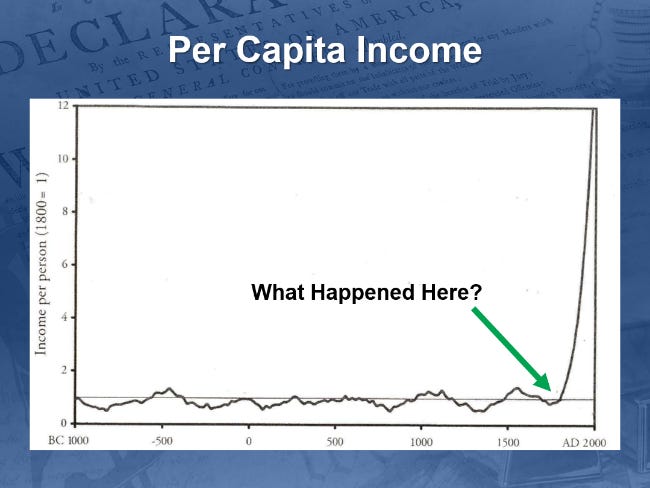
“Capitalism” often conjures images of ill-gotten riches, chaotic stock exchanges, and faceless skyscrapers. This is a tragic misconception of the term. It ignores the profound reality that the human mind is the source of wealth—a truth humanity struggled to recognize for thousands of years until the Enlightenment.
With individual rights protected, people like John D. Rockefeller could experiment and create—building the new and the wondrous from the raw materials of the Earth. Defending capitalism is more than advocating for lower taxes, fewer regulations, or smaller government. It also requires defending the individual’s right to think, to create, and to carry the torch of discovery, progress, and prosperity into a better future.